
Table of Contents
It is 12:40 on a busy Friday. The dining room is full, tickets are stacking up, and your combi oven just flashed a code and stopped mid-cycle. Half-cooked trays are inside. The chef is staring at the display. Nobody remembers what “Service 29” or “E16” actually means.
Sound familiar? If you run a restaurant, hotel kitchen, cloud kitchen or catering unit in Dubai, this is one of the most stressful equipment problems you can face. A combi oven is the workhorse of a modern kitchen, so when it goes down, service slows, food gets wasted, and money walks out the door.
The good news is that many error codes are easier to deal with than they look. This guide, How to Reset and Clear Common Error Codes on Commercial Combi Ovens, explains what the codes mean, which ones you can safely reset yourself, which ones need a technician, and how to stop them coming back. It is written for real kitchen teams, not engineers, so we keep the language simple.
Quick answer: To clear most commercial combi oven error codes, write down the code, switch the oven off, wait a few minutes, restart it, and run a rinse or abort program if the display asks for one. If the same code returns, do not keep resetting. Something is failing, and it is time to call a technician for combi oven repair in Dubai.
What Do Commercial Combi Oven Error Codes Actually Mean?
A combi oven (also called a combi steamer) mixes dry heat and steam in one cabinet. To do that safely, it constantly checks itself. Temperature sensors, a core temperature probe, water level sensors, fan motors, valves, and a circuit board all report back to the control panel.
When one of those parts gives a reading that makes no sense, or stops reporting at all, the oven protects itself. It shows an error code on the digital display and often shuts the cycle down. Think of the code as the oven telling you where it hurts. It is a control panel diagnostic, not a death sentence.
A few things are worth knowing before you panic:
- Codes are brand and model specific. The same number can mean different things on different machines. Always check your operator or service manual.
- A code points to an area, not always to a broken part. A water error may be a blocked filter, a kinked hose, or a scaled-up sensor, not a failed pump.
- Some codes clear on their own once the cause is fixed. Others stay locked until you finish a rinse program or an abort program.
- Repeat codes are a warning. One random error can be a glitch. The same error three days in a row means a part is on its way out.
Why Combi Ovens Throw More Error Codes in Dubai Kitchens
Combi ovens work hard everywhere, but Dubai kitchens put them under extra pressure. If you have noticed more faults than a kitchen in a cooler country would see, these are the usual reasons.
1. Heat around the machine. Hot kitchens, crowded cooking lines and blocked air vents push the temperature of the electronics up. The circuit board and control panel have built-in limits, and when they overheat, the oven throws a temperature alarm.
2. Hard water and limescale. Water quality in many UAE kitchens is high in minerals. Scale builds up on the steam generator, the water level sensor and the valves. Sensors then give wrong readings and water error codes appear.
3. Long operating hours. Hotels, cloud kitchens and catering units often run ovens from early morning to late night. Parts such as fan motors, door seals and probes simply wear out faster.
4. Grease and humidity. Steam, oil vapour and cleaning chemicals slowly reach connectors and panel gaskets. Corroded contacts cause communication and sensor errors.
5. Skipped maintenance. When service is delayed because the kitchen is too busy, small faults grow into big ones.
Safety First: Read This Before You Touch the Oven
Commercial combi ovens combine electricity, high heat, pressurised steam and sometimes gas. A reset is fine for staff to try. Opening panels is not.
- Never open the control panel or electrical compartment unless you are a trained technician.
- If you smell gas, stop immediately. Do not touch switches, open windows, leave the area, or call emergency services and a qualified gas technician.
- Let the oven cool down before cleaning or checking anything inside the cabinet. Hot steam and surfaces cause serious burns.
- Keep water away from the control panel and never spray the oven with a hose.
- Do not bypass sensors or safety switches to keep cooking. That is how small faults become fires and injuries.
If the problem involves your building’s power supply, such as a tripped breaker, a flickering light, or a burning smell, you may need an electrician as well. Our electrical services in Dubai team can check the supply while we look at the oven.
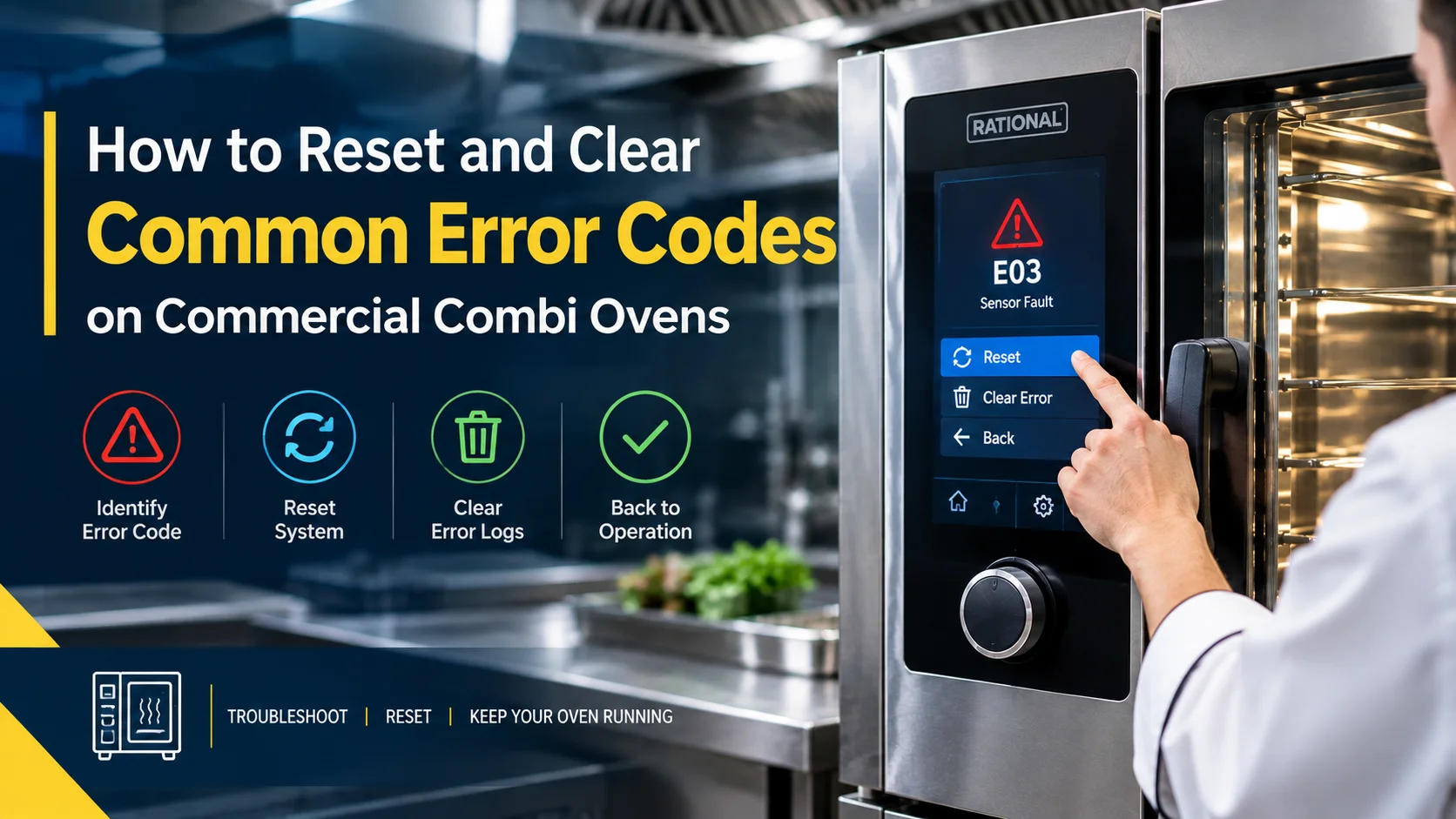
How to Reset and Clear Common Error Codes on Commercial Combi Ovens: The 6-Step Method
Use this routine whenever a code appears. It is safe for kitchen staff and solves a surprising number of nuisance faults.
Step 1: Write down the code exactly
Take a photo of the display. Note the full code, including any numbers after a dot or slash. A code such as 20.1 and 20.4 look similar but point to different sensors. This note will save your technician a lot of time.
Step 2: Check the basics
Before resetting, look for simple causes:
- Is the water tap open and is the water pressure normal?
- Is the drain blocked or the drain hose kinked?
- Are the air filter and the cooling vents clean?
- Is the door fully closed and the seal undamaged?
- Has a breaker tripped or has the power supply dropped?
Step 3: Switch the oven off and wait
Turn the oven off at the control panel, then at the isolator or breaker. Wait at least five minutes. This lets the control board clear temporary memory and lets hot parts cool.
Step 4: Switch it back on and watch the display
Restart the oven. If the display is clear, run a short test cycle with an empty cabinet before loading food.
Step 5: Run the program the oven asks for
Some codes only clear after a rinse program or an abort program finishes successfully. Several water and cleaning-related faults on Rational-type ovens behave this way. If your display tells you to run a rinse or abort program, follow it fully. Do not interrupt it.
Step 6: Decide: fixed, or call a technician?
If the code is gone and stays gone for a full day of cooking, you are fine. If it comes back within hours, or if it is a safety-related code such as ignition, overheating, or a short circuit, stop resetting. Repeated resets can hide a real fault and damage the part further.
Common Combi Oven Error Code Families and What to Do
Every brand uses its own numbers, but nearly all codes fall into the same handful of families. The examples below come from commonly published Rational service code lists. Use them as a guide to understand the pattern, then confirm against your own manual.
| Code family | Example codes (Rational-style) | Likely cause | What you can try | Call a technician if… |
| Temperature sensor or probe fault | Service 20.x, E3 to E7 | Broken or loose thermocouple, damaged core probe | Check the probe is seated and undamaged, then reset | The code returns or the oven overheats |
| Water and steam generator | Service 10 to 14 | Low water pressure, scaled level electrode, blocked path, low water conductivity | Check tap, filters and hoses, run a rinse program | Scale is heavy or the pump or valve is faulty |
| Drain valve and cleaning cycle | Service 25 to 27 | Low water flow, stuck or blocked drain valve | Clear the drain, check water supply, run the abort or rinse program | The valve will not open or close |
| Overheating of the circuit board | Service 29, E15 | Blocked air filter, failed cooling fan, hot kitchen | Clean the air filter, clear vents, let the oven cool | The fan is noisy, stopped or the code repeats |
| Steam generator over temperature | Service 28, E16 | Scale, faulty sensor, relay problem | Let it cool and restart | Immediately if it repeats |
| Ignition box (gas ovens) | Service 32, 33, E20 to E23 | Gas supply, wiring or failed ignition box | Check the gas valve is open only | Always. Gas faults need a qualified technician |
| Communication or bus error | Service 34, 35 | Loose or damaged bus cable or plug, disconnected unit | Power cycle once | Always. Do not open the panel yourself |
| Memory or SD card | Service 17 to 19 | SD card missing, dirty or defective | Reinsert or replace the card | The control board cannot read it |
| Pressure or care system | Service 36, 37, 40 to 44 | Differential pressure sensor, hoses, care pump or solenoid | Check hoses for kinks, complete a rinse program | The code remains after rinsing |
Sensor and probe errors
These are among the most common codes. The oven cannot read the temperature inside the cabinet, the steam generator, or the food, so it stops to avoid overcooking or overheating. Loose connectors, grease on the probe, and age are the usual causes. Cleaning and reseating a probe can help, but a cracked or failed sensor must be replaced with a proper OEM part to keep readings accurate.
Water, steam and drain errors
If the oven cannot fill, heat, or empty water properly, you will see these codes. In Dubai, limescale is the number one suspect. Scale coats the level electrode so the oven thinks there is no water, even when the generator is full. Regular descaling and a good water treatment system prevent most of these faults.
Overheating errors
When the circuit board or steam generator gets too hot, the oven shuts itself down. Start with the easy checks: air filter, ventilation gaps, and whether the machine is pushed against a hot wall or fryer. Cleaning the filter fixes more overheating alarms than most people expect.
Ignition and gas errors
Gas combi ovens use an ignition box and flame sensing. If the oven cannot light, it locks out for safety. The only thing staff should check is whether the gas supply valve is open. Everything else is for a qualified technician.
Communication errors
These appear when the control board loses contact with a motor, an ignition module, or another component. They are often caused by a damaged cable or corroded connector, and sometimes by a failing board. Because this involves live electrical parts, a technician should inspect it.
Is It the Control Panel or the Commercial Oven Circuit Board?
Many owners ask us this after a few resets fail. The truth is that the circuit board is usually the messenger, not the culprit. A proper control panel diagnostic looks at the whole chain: the sensor, the wiring, the connector, the power supply, and then the board itself.
Signs that point to a genuine circuit board problem include:
- Several unrelated error codes appearing together
- A blank, flickering or frozen digital display
- Buttons or touchscreen not responding
- Codes that appear the moment you power the oven on
- Burn marks, a burning smell or moisture inside the panel
Replacing a commercial oven circuit board is not a cheap job, so a good technician will test every other likely cause first. That is exactly how we work. We confirm the fault before we recommend any part, so you never pay for a board you did not need.
Mistakes That Make Combi Oven Errors Worse
We see the same avoidable mistakes in kitchens all over the city.
- Resetting again and again. Each reset hides the symptom. If a part is failing, it keeps failing.
- Ignoring a small code because the oven still cooks. Even if the oven seems to work, the code is warning about a fault that can get worse.
- Using the wrong cleaner or skipping descaling. Harsh or incorrect chemicals damage seals and sensors. Scale damages everything else.
- Pressure washing the control panel. Water inside the panel is one of the fastest ways to destroy a circuit board.
- Buying cheap, non-OEM parts. Parts that do not match the original specification often cause new error codes.
- Letting untrained people open the oven. A wrong connection can cause a short circuit or injury.
Simple Maintenance Checklist to Prevent Error Codes
Prevention is cheaper than an emergency call-out. A short routine keeps your combi oven reliable, and it supports the food safety standards that Dubai Municipality inspectors expect to see in a well-run kitchen.
Every day
- Run the automatic cleaning cycle or clean the cabinet after service
- Wipe the door seal and glass
- Check that the drain is clear
Every week
- Clean or replace the air filter
- Check the hoses for kinks or leaks
- Wipe the control panel with a slightly damp cloth, never a wet one
Every month
- Descale the steam generator as your manual recommends, more often if your water is hard
- Check the core probe and sensors for damage
- Look at the door hinges, latch and seals
Every 6 to 12 months
- Book a professional service to test sensors, valves, fan motors, ignition parts and electrical connections
The easiest way to stay on schedule is a service plan. Our Annual Maintenance Contract (AMC) keeps scheduled visits on the calendar so small faults are caught before they stop your kitchen.
When to Call for Combi Oven Repair in Dubai
You have done your best, and the oven is still not right. Call a technician straight away if:
- The same error code returns after a reset
- The oven shows an ignition, gas, overheating, or short circuit code
- You see sparks, smoke or smell burning
- Water leaks from the cabinet or the drain
- The display is blank, frozen, or unresponsive
- The oven heats unevenly, or the steam and temperature are clearly wrong
If the tips in How to Reset and Clear Common Error Codes on Commercial Combi Ovens did not hold, you are not alone. Most repeat faults come from a worn part or heavy scale that no reset can fix.
At Dubai Home Care Pro, we handle repair and maintenance for homes and businesses across Dubai, including Business Bay, Dubai Marina, Jumeirah, Deira, Al Qusais and Al Satwa. When you contact us for combi oven repair in Dubai, it helps to have these details ready:
- The brand and model (for example Rational, Convotherm or Unox)
- The exact error code, ideally as a photo
- When it started and what the oven was doing
- Whether it is gas or electric
With that information, we can usually tell you the likely cause before we even arrive.
Frequently Asked Questions
What do the different error codes mean on a combi boiler?
A combi boiler is a home heating and hot water boiler, which is different from a commercial combi oven. Boiler codes usually point to low water pressure, a blocked condensate pipe, ignition failure, a faulty pump, or an overheating sensor, and the exact meaning depends on the brand. If you meant a commercial combi oven, the codes are in the sections above. For either machine, check the manufacturer’s manual and call a qualified technician for anything involving gas.
What do the different error codes on my oven mean?
Error codes are the oven’s way of reporting a problem it has detected. In commercial ovens, they usually fall into a few groups: temperature sensor faults, water or steam problems, overheating, ignition failure, fan or motor trouble, communication errors, and control board faults. The number or letter combination is specific to each brand, so the same code can mean something different on another model. Check your service manual, or send us the code and model, and we will help you read it.
What are common error codes?
The most common ones are sensor or probe errors, water supply and drain errors, overheating alarms, ignition failure on gas models, and communication errors between the control board and other parts. In Dubai, water-related codes caused by limescale and overheating codes caused by hot, cramped kitchens appear especially often.
How do I reset my oven error code?
Note the code, switch the oven off at the panel and the isolator, wait about five minutes, then switch it back on. If the display asks you to run a rinse or abort program, complete it fully. Then test with an empty cycle. If the code returns, stop resetting and book a technician, because a repeat code means the cause is still there.
Is it safe to keep using a combi oven that shows an error code?
It is not recommended. Even if the oven seems to work, the code points to a fault that can get worse or become unsafe, especially with ignition, overheating or electrical codes. Fix the cause first.
How often should a commercial combi oven be serviced?
A professional service every 6 to 12 months is a sensible baseline, and more often for kitchens that run all day or have hard water. Daily and weekly cleaning by your own team fills the gap in between.
Final Thoughts
Error codes feel dramatic, but they are really just information. Once you know the pattern, you can write down the code, run a safe reset, check the simple causes, and know when to hand the job over. That is the whole idea behind How to Reset and Clear Common Error Codes on Commercial Combi Ovens: stay calm, act safely and keep your kitchen moving.
A clean oven, softened water, a free air filter and a regular service visit prevent most breakdowns. And when a code just will not clear, a quick call saves you far more than it costs.